Cosplay Timeline: From Concept to Convention
The most common cosplay regret isn't a bad seam or a wig that wouldn't cooperate. It's the photo from con day where you can see, in your own eyes, that you ran out of time. The boots are still the wrong color. The belt is held together with safety pins under the jacket. The prop you swore you'd finish is sitting on your kitchen table at home.
Almost every cosplayer learns the same lesson the hard way: a build doesn't fail because the work was too hard. It fails because the work wasn't planned in time to do it well. A real cosplay timeline — one that works backwards from con day, accounts for shipping delays, and leaves room for the things you can't predict — is what separates a costume that comes together from one that comes apart.
This guide walks through how to build that timeline, with a 12-week template you can adapt to almost any costume, plus the buffer zones, tracking tools, and mid-build adjustments that keep it from collapsing.
Why Cosplay Deadlines Slip
Before the template, it helps to understand why timelines fail. Once you've seen the patterns, you can build a schedule that resists them.
Optimism about ordering. A bolt of fabric you order on Monday won't always arrive on Friday. Specialty materials — Worbla, EVA foam in unusual thicknesses, contacts, certain wig colors — often ship from overseas warehouses with 2-3 week lead times. Cosplayers consistently underestimate this and discover the problem two weekends before the con.
The "I'll figure it out later" trap. It's easy to skip a step in planning when you're not sure how to solve it. Maybe you don't know yet how to attach the wings, or how the boot covers will close. Unsolved problems don't go away — they just get more expensive (in time and money) the closer to con you tackle them.
Hidden tasks. Almost every costume has a long tail of small jobs that don't appear in the initial plan: weathering, edge sealing, snap installation, pressing, photo touch-ups for the wig, adjusting the hem after you put the shoes on. Add them up and they routinely consume an entire week of the build.
Life. Work goes sideways. Someone gets sick. Your sewing machine eats the bobbin case. Your timeline has to absorb these without snapping.
A good cosplay timeline assumes all four will happen and plans around them.
Work Backwards From Con Day
The single biggest shift in how you build a timeline is to start from the end. Pick your convention date. Then your "ready by" date is at least one week before the convention — not the day before.
That extra week exists for a reason. It's where you fix the things that fail when you actually wear the costume:
- The seam that pulls when you raise your arm
- The prop that's a quarter inch too long to fit in your luggage
- The wig that looks great on the head form but slides backwards when you walk
- The boots that pinch at the toe and need reshaping
- The undergarments you forgot you'd need
If you finish a costume and immediately wear it for an hour around your house, you will find at least two of these. You want to find them with seven days to spare, not seven hours.
Once you've set "ready by" as one week before con, work backwards from there in phases.
The 12-Week Cosplay Timeline Template
Twelve weeks is the standard window most experienced cosplayers use for a moderately complex build (sewn costume + light prop work + styled wig). Simple closet cosplays can compress to 4-6 weeks. Full armor sets often stretch to 16-20 weeks. The phase structure stays the same — only the durations change.
Read this as "weeks before con day," counting backwards from week zero (con weekend).
Week 12-11: Reference & Research
This is where the build is won or lost, and almost no one spends enough time here. Two solid weeks of research saves a month of rework later.
What to do:
- Collect 30-50 reference images from every angle (front, back, sides, three-quarter, close-ups of hands, feet, accessories). Official art alone is rarely enough.
- Identify the canonical version. If your character has multiple outfits, pick one and commit.
- Watch construction videos for the techniques you'll need (e.g., "EVA foam pauldron tutorial," "lace front wig styling for short cuts").
- Note the unanswered questions. Write them down. These are the problems you'll solve in week 10.
Deliverable: a folder of references organized by category — costume, props, makeup, wig, accessories.
Week 11-10: Materials List & Budget
With references locked, you can build a real materials list. Don't skip the budget step — running out of money mid-build is just as common as running out of time, and they tend to happen together.
What to do:
- Break the costume into components (top, bottom, jacket, belt, gloves, boots, wig, prop).
- For each component, list every material with quantity and source.
- Get prices. Add 15% for shipping, tax, and the inevitable "I need one more yard."
- Decide what you'll buy vs. make vs. commission. Commissioned pieces need to be ordered now so they arrive on time.
If your total is way over budget, this is the moment to scale down — not week 4 when you've already cut the fabric.
Week 10-9: Order Everything
Place every material order this week. Yes, all of them.
This is the most counterintuitive rule in cosplay planning, and the one most likely to save your build. Scattering orders across the timeline means you're constantly waiting for something. Ordering everything in week 10 means by week 8 your supplies have arrived, and from that point forward you are only ever blocked by your own work.
If a supplier is back-ordered, you find out now (with two months to find an alternative) instead of in week 4 (with no time to switch).
Week 9-7: Mockups and Patterning
Three weeks for the unsexy work that determines whether your costume fits.
What to do:
- Make a muslin (or cheap fabric) mockup of every sewn piece.
- Try it on. Adjust the pattern.
- Pattern any custom pieces from scratch — collars, capes, asymmetric details.
- For armor: draft templates on paper, test the fit, then transfer to foam.
Skipping mockups is the single fastest way to ruin expensive fabric. A two-hour mockup saves a 12-hour rework.
Week 7-5: Main Construction
The longest phase. This is where you'd expect cosplay planning to focus, but notice that by the time you start it, you've already spent five weeks on prep — and you're going to be glad you did.
What to do:
- Cut all fabric pieces.
- Sew the major garments.
- Build prop bases.
- Cut and shape armor pieces.
Schedule construction in work blocks, not "I'll work on it whenever." Two evenings per week and one weekend afternoon is a sustainable cadence for most people. Burnout is a real timeline killer — three nights of frantic sewing followed by two weeks of avoidance is much slower than steady weekly progress.
Week 5-3: Detail Work
Construction is done. Now the parts that make it look finished:
- Trim, piping, edge binding
- Embroidery, painted details, decals
- Weathering and edge sealing on props and armor
- Hardware (snaps, buckles, hooks, hidden zippers)
- Lining seams and pressing
Detail work consistently takes 2-3x longer than people estimate. This is where you cash in the buffer.
Week 3-2: Wig and Makeup
Wigs deserve their own phase because they're often treated as an afterthought and then ruin the photos.
What to do:
- Wash and de-tangle the wig.
- Cut and style on a head form.
- Set with hairspray, test under different lighting.
- Practice your makeup look at least twice. Photograph each attempt to see what the camera sees, not what the mirror shows.
- Test contacts (if applicable) for full-day comfort.
Week 2-1: Full Wear Test
The most-skipped step in cosplay planning. Put on the entire costume — wig, makeup, contacts, shoes, props, everything — and wear it for at least an hour.
You're testing for:
- Visibility (especially if you have a mask or large prop)
- Mobility (sitting, climbing stairs, reaching)
- Comfort over time (where does it pinch, dig, or chafe?)
- Photo angles (does the costume read from a distance?)
- Travel readiness (will the prop fit in your bag? Does the costume pack down without crushing?)
This is also when you'll find the things you forgot — the safety pins, the moleskin for blisters, the bobby pins for the wig, the touch-up makeup. Add them to your packing list.
Week 1: Repair Kit, Packing, and Rest
The final week is for logistics and rest, not construction. If you're still finishing the costume in week 1, your timeline drifted and you should learn from it for next time.
What to do:
- Build a convention repair kit — needle, thread, hot glue gun, super glue, safety pins, fabric tape, makeup touch-up.
- Pack the costume properly. Fold to minimize creases. Pack hard props separately.
- Print or save your panel/event schedule.
- Sleep. Cons are exhausting and a tired cosplayer makes more mistakes than a well-rested one.
Buffer Zones (Where to Build Them In)
The 12-week template above includes hidden buffer in two places: the construction phase (which is generously sized) and the detail phase (which always runs long). For most builds, this is enough.
For ambitious projects, add explicit buffer:
- One full empty week between construction and detail work, to absorb delays.
- Two empty days before the wear test for last-minute fixes.
- A "skip week" mid-build where nothing is scheduled — useful if you know you have a busy work week or travel coming up.
The mistake is treating buffer as "extra time to do more." It's not. Buffer is for the problems you didn't predict. If you fill it with new ideas, you have no buffer left.
Track the Timeline (Or It Won't Hold)
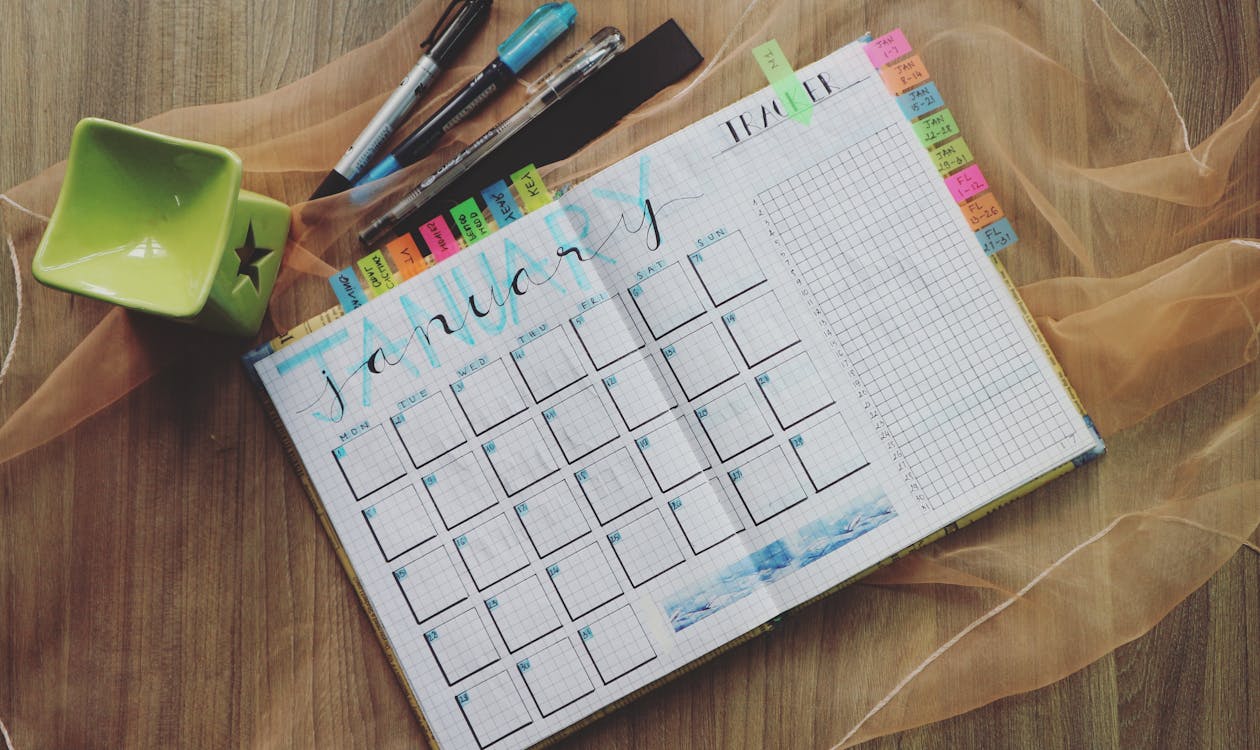
A timeline written once on a Sunday afternoon and never looked at again is just a wish. The cosplayers who consistently finish on time check their plan every few days and adjust as reality unfolds.
There are several ways to do this — a paper bullet journal works fine if you stick with it, and a spreadsheet works if you maintain it. The challenge with both is that they live separately from your actual to-do list. You end up with the plan in one place, the shopping list in another, and your reference images in a third.
This is exactly the gap Cosplai was built to close. Cosplai is a cosplay planning app for iOS and Android that ties your tasks, due dates, references, and budget together in one place — and it's the only cosplay-specific app with a built-in calendar that shows every task across all your projects in one view. Tap any date to see what's due that day; tap a task to mark it complete or jump to its project. Reference images live alongside the tasks they belong to, and your running budget total updates as you mark items as ordered or finished. For timeline planning, the calendar view is the difference between "I have a plan" and "I can see my plan" — which is the difference that determines whether the plan actually gets followed.
If you'd rather start with a paper system, that's fine too. The point isn't the tool; it's the daily glance. Whatever you use, look at it.
Common Cosplay Timeline Mistakes
These are the patterns that derail builds even when the plan was good:
Front-loading the fun stuff. It's tempting to start with the parts you're excited about — the prop, the wig, the cool accessory. Resist. Front-load the uncertain stuff instead. The pieces you're most worried about should be tackled first, while you still have time to fail and try again.
Underestimating "small" pieces. Belts, gloves, sashes, and accessories routinely take 2-3 days each. A costume with five small accessories is two weeks of work disguised as five days.
Working without finished references. Starting construction before your reference is locked means you'll change your mind mid-build. Every change costs hours. Lock the references in week 12 and don't open Pinterest again until week 5.
Ignoring shipping windows. International suppliers, custom commissions, and out-of-stock items can stretch lead times to 4+ weeks. Order in week 10, not week 6.
No mid-build review. Plan a 30-minute check-in every two weeks where you compare your actual progress to the timeline. Adjust early. The cosplayers who finish on time are the ones who notice they're behind in week 7, not week 2.
What to Do When You Fall Behind
You will fall behind. Every cosplayer does, on every build. The question is what you do about it.
Triage in three buckets:
- Must finish: the silhouette pieces. The costume reads or it doesn't.
- Should finish: the visible details that sell the character.
- Nice to have: the bonus pieces — the prop accessory, the second wig style, the screen-accurate fingernails.
When time gets tight, cut from the bottom up. A clean, complete silhouette with simplified details photographs better than a half-finished version of the ambitious plan. Nobody at the con knows what you originally meant to do — they only see what walked through the door.
If you're behind by more than a week with three weeks left, consider deferring the build. Saving a costume for the next con weekend is not a failure. Showing up exhausted in a half-finished costume usually is.
A Note on Group Cosplay Timelines
If you're building a group cosplay, your timeline isn't just yours. Someone always finishes first and someone always finishes last, and the slow person sets the photo schedule.
The fix is shared visibility. Everyone in the group should be able to see everyone else's progress, so it's obvious in week 6 (not week 1) who needs help. Group chats work for casual coordination but tend to lose information; a shared planning system — whether a shared Notion page, a Trello board, or Cosplai's task collaboration features for friends — keeps the group aligned without anyone having to constantly ask "how's it going?"
Build in a group photoshoot rehearsal during week 1 if you can. It catches mismatched poses, prop conflicts, and color issues that you can't see in your individual mirror.
Putting It Together
A cosplay timeline isn't about being rigid. It's about giving yourself enough information to make good decisions as the build unfolds — to know when you can take a weekend off, when you need to call for help, and when it's time to scale back the plan.
Build the timeline backwards from con day. Order materials in week 10. Mockup before you cut. Detail work takes longer than you think. Buffer is for problems, not new ideas. Check the plan every few days. When you fall behind, cut from the bottom of the priority list, not from the top.
Do that, and the photo from con day is the one you wanted to take.
Ready to plan your next build? Cosplai gives you the calendar, task list, references, and budget tracking in one place — free to start, with unlimited projects on Pro. The in-app calendar shows every due date across every project, so your timeline lives somewhere you'll actually look at it.
 ✨⭐✨
✨⭐✨Ready to Plan Your Next Cosplay?
Track projects, manage budgets, discover conventions, and connect with the cosplay community — all in one app.
Download Cosplai FreeRelated Articles
How Much Does Cosplay Cost? Real Budgets
What cosplay actually costs, from $40 closet builds to $900 armor. Real price breakdowns by costume type, hidden costs, and how to stay on budget.

How to Find Cosplay Friends & Build Community
Making cosplay friends feels intimidating, but it doesn't have to. Here's how to find your community online and at cons—and actually stay in touch.